45W Non-Standard Charger PPS Testing Specification Protocol Parameters ≠ Actual Output, Load Tester Measurement Is the Standard
author: Nina-dpl
2026-05-16
With the rapid iteration of fast charging technology, the PPS (Programmable Power Supply) protocol has become the core configuration of 45W non-standard chargers. Its dynamic voltage regulation feature can accurately adapt to the charging needs of different devices. However, in daily quality inspection and testing, the difference between PPS protocol parameters and the actual output capacity of the charger is often ignored, leading to misjudgment of product performance and loss of factory quality control. As a professional charger manufacturer, we take the 127 45W non-standard charger as a case to clarify the core specifications of PPS testing: protocol parameters are for reference only, and load tester measurement is the only standard to determine the actual output capacity, providing authoritative guidance for factory quality inspection, technological research and development, and quality control.
I. Comparison Between PPS Protocol and Actual Output Parameters of 127 45W Non-Standard Charger
As the core function of the USB PD 3.0 specification, the PPS protocol can theoretically support a wide voltage range of 5.0V-21.0V and a maximum current output of 5A. However, the actual output of the charger is limited by multiple hardware factors such as PCBA board design, component selection, and heat dissipation performance. Protocol parameters ≠ actual output capacity, and this difference is particularly significant in non-standard chargers.
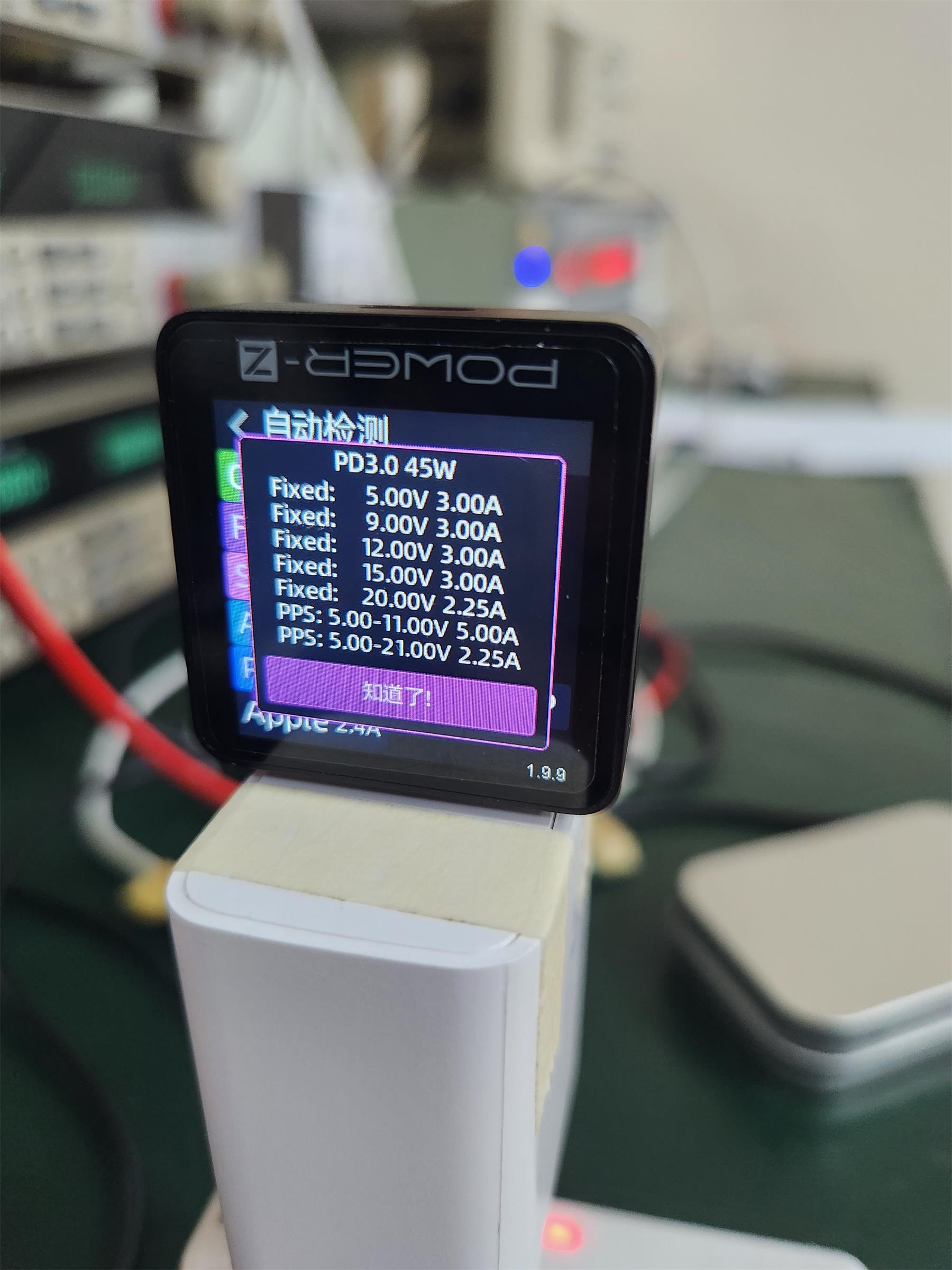
For the 127 45W non-standard charger, we completed dual tests through professional equipment, and the parameter difference is clearly distinguishable:
-
PPS Protocol Test (Power Z Tester): The detected protocol support gears are PPS DC 5.0V-11.0V 5.0A; 5.0V-21.0V 2.25A. This is the theoretical maximum value of the protocol, which only represents the fast charging handshake range that the charger can respond to and has no reference value for actual output.
-
Actual Output Test (Load Tester): Simulating real charging scenarios, the actual stable output gears are confirmed to be PPS DC 5.0V-11.0V 3.0A; 5.0V-21.0V 2.25A. This parameter is determined by the hardware bearing capacity of the charger and is a direct reflection of the real performance of the product.
The core difference between the two focuses on the 5.0V-11.0V low-voltage and high-current gear: the protocol nominal is 5.0A, but the actual stable output is only 3.0A. If tested according to the protocol parameters, the product output will be misjudged as up to standard, leaving hidden quality hazards such as overload heating, unstable charging, and equipment damage.
II. Core Reasons for the Difference Between PPS Protocol and Actual Output
1. Protocol is "Handshake Language", Output is "Hardware Capacity"
The PPS protocol is essentially a communication protocol between the charger and the terminal device, which is only responsible for "informing the device of the available voltage and current range", similar to a "capacity commitment". The actual output depends on the bearing upper limit of core components such as transformers, capacitors, MOSFETs, and main control chips inside the charger, as well as the current bearing design of the PCB board and the temperature control capacity of the heat dissipation structure, which is a direct reflection of hardware performance.
2. Hardware Configuration Adaptability Limitations of Non-Standard Chargers
As a non-standard charger, the 127 45W optimizes component selection and circuit design according to the actual output of 3.0A (5.0V-11.0V) to balance cost and performance, instead of configuring hardware according to the theoretical peak of 5.0A in the protocol. Forcing output at 5.0A according to the protocol will lead to component overload heating, voltage drop, trigger protection mechanism, and even damage the charger or charging equipment, which is the core reason why the protocol parameters of non-standard chargers are generally higher than the actual output.
3. Load Tester Measurement Simulates Real Scenarios and Eliminates Theoretical Interference
Power Z only detects protocol handshake signals and does not simulate real charging loads; while the load tester can accurately simulate the charging load state under different voltages and currents, and real-time monitor voltage stability, current bearing capacity, and power output continuity, which is completely consistent with the actual user usage scenario, and the test results are more referenceable.
III. Factory Execution Standards for PPS Testing of 127 45W Non-Standard Chargers
To strictly control product quality and avoid quality problems caused by ambiguous testing standards, the factory has formulated mandatory execution standards for PPS testing of 127 45W non-standard chargers. All products must complete load tester measurement before leaving the factory. The specific requirements are as follows:
1. Test Equipment Requirements
-
Protocol Detection: Power Z fast charging protocol tester (only used for protocol filing, not for qualification judgment).
-
Actual Output Detection: Programmable electronic load tester (accuracy ±0.1%, supporting precise adjustment of 5.0V-21.0V voltage and 0-5A current).
2. Qualification Standards for Measured Parameters
-
Low-Voltage Gear (5.0V-11.0V): Stable output of 3.0A, voltage fluctuation ≤±5%, no voltage drop, no protection, no abnormal heating.
-
High-Voltage Gear (5.0V-21.0V): Stable output of 2.25A, voltage fluctuation ≤±5%, no abnormality after continuous output for 30 minutes.
3. Test Process Specifications
-
First, use Power Z to detect the PPS protocol, record the protocol parameters, and complete the protocol filing.
-
Then, use the load tester to measure according to 5.0V-11.0V/3.0A, 5.0V-21.0V/2.25A. Each gear is continuously tested for 30 minutes, and voltage, current, and temperature data are recorded in real time.
-
Only when the measured parameters of the load tester are up to standard can the product's PPS output be judged as qualified and allowed to leave the factory; if only the protocol parameters are up to standard but the actual measurement is not, it shall be judged as unqualified product and prohibited from leaving the factory.
-
Technological R&D: Design circuits and select components according to the actual output capacity, do not blindly pursue the peak of protocol parameters, and ensure that hardware performance matches the actual output.
-
Quality Inspection and Control: Strictly implement the load tester measurement standard, eliminate perfunctory testing of "replacing actual measurement with protocol", and fundamentally prevent products with false parameters and substandard performance from flowing out.
-
Product Commitment: All product parameters are based on the load tester measurement results, and the actual output capacity is truthfully marked to provide customers with real, reliable, and stable fast charging products.
Difference Between AVS and PPS Fast Charging Protocols: B2B Selection & Consumer Usage Guide
What is UFCS Protocol? Complete Guide for Charger Manufacturers & Users 2026
Related Article
Difference Between AVS and PPS Fast Charging Protocols: B2B Selection & Consumer Usage Guide
Difference Between AVS and PPS Fast Charging Protocols: B2B Selection & Consumer Usage Guide

This guide explains UFCS Protocol and UFCS Charger, highlighting their core value and benefits for charger manufacturers.
What is UFCS Protocol? Complete Guide for Charger Manufacturers & Users 2026